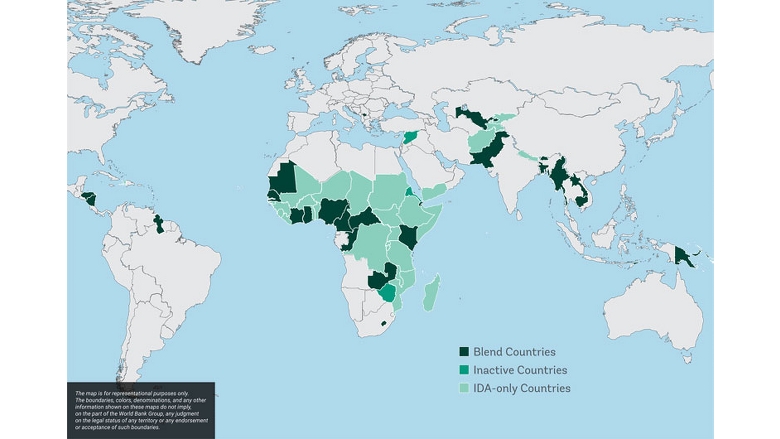
The human costs are immense, and the economic scars endure. That is why the International Development Association (IDA)—the World Bank’s fund for low-income countries—remains engaged. IDA supports countries to prevent crises, strengthen resilience, and seize opportunities for recovery.
IDA’s commitments in FCV settings have grown significantly: financing to these countries has tripled between IDA16 and IDA19, and in IDA20, nearly 40 percent of new financing was directed to FCV contexts. As a trusted long-term partner, IDA works alongside governments and development actors to protect hard won gains and lay the groundwork for stability and growth.
IDA’s approach is flexible, fast, and innovative. Through instruments like the Crisis Response Window, the FCV Envelope, the Private Sector Window, the Regional Window, and the Window for Host Communities and Refugees, IDA delivers timely responses to evolving challenges, fast moving crises, and complex risks. These resources help keep essential services running, strengthen institutions, and expand opportunities—especially for displaced people and their host communities.
Even in the most fragile contexts, IDA helps countries move from crisis to opportunity: expanding access to education, healthcare, and basic infrastructure; fostering private sector mobilization and job creation for growing working age populations; and building social cohesion and institutional resilience. These efforts are complex and long term, but they are essential to helping countries break cycles of fragility and lay the foundations for a more resilient and hopeful future.
BURKINA FASO
Between 2013 and 2023, 1.29 million people received cash transfers, thereby reducing food insecurity and enhancing human capital. As a result, 81% of mothers improved their nutritional practices, school enrollment rose by 13.1%, and grade progression for children aged 6 to 15 increased by about 15%.
CAMEROON
Between 2018 and 2023, 750 community schools received grants, as well as support for teachers and textbooks, thereby improving the learning environment for children, including refugees. 18,000 teachers were recruited, and the textbook-to-pupil ratio improved from 1:17 to one package for every two pupils in French, English, and Mathematics.
CENTRAL AFRICAN REPUBLIC
Between 2019 and 2025, 104,177 small-scale farmers benefited from increased agricultural productivity, strengthening the capacity of micro, small, and medium agribusinesses. Agricultural productivity has doubled, with yields per hectare of selected crops rising by 100%.
DEMOCRATIC REPUBLIC OF CONGO
Between 2019 and 2024, 11.7 million women and children received vital health and nutrition services. More than 1 million women accessed post-partum family planning services, and over 416,000 children were treated for severe acute malnutrition.
ETHIOPIA
Between 2015 and 2024, 1.6 million smallholder farmers adopted improved technologies, benefiting 62,228 hectares with irrigation and drainage services. This initiative created 1 million rural jobs, including 396,000 for women and 505,000 for youth in fragile and conflict-affected regions.
HAITI
Between 2018 and 2024, 9,000 farmers received climate-resilient seeds, while nearly 140,000 received essential fertilizers. Additionally, 112 new Farmer Field Schools support 2,800 farmers in adopting improved agricultural practices.
Between 2017 and 2025, a total of 475 kilometers of roads were rehabilitated, and 650,000 people are now living in areas served by connecting roads upgraded to a climate-resilient standard.
MOZAMBIQUE
Between 2022 and 2025, 1 million displaced people and individuals in host communities have benefited from services and livelihood support.
From 2015 to 2021, 1.44 million people benefited from the restoration of essential infrastructure in disaster-affected provinces. Additionally, over 159,000 individuals now have access to improved educational facilities, and rehabilitated dike systems protect 69,000 people.
Between 2018 and 2024, about 590,000 metric tons of emissions were avoided annually due to reduced deforestation, while 600,000 hectares of landscapes were improved for better conservation management.
MYANMAR
Between 2012 and 2022, 8.5 million people in more than 12,000 villages benefited from the rehabilitation and construction of basic infrastructure and services, including transportation, water and sanitation, education, electrification, community facilities, and health facilities.
REPUBLIC OF YEMEN
Between 2021 and 2025, 23.9 million beneficiaries received health and nutrition services at health facilities and through outreach and mobile teams. Additionally, 1.5 million people gained access to improved water supply and sanitation.
SOMALIA
Between 2019 and 2025, 2 million people have benefited from social safety net programs, with nearly half being female. Additionally, 200,000 beneficiaries have received predictable nutrition-linked cash transfers to address their immediate consumption gaps and mitigate the risks of food insecurity and malnutrition.
SOUTH SUDAN
Between 2021 and 2024, 3.7 million people received essential health and nutrition services. Additionally, 1.78 million people affected by the food insecurity crisis received nutritional services.
SUDAN
Between 2020 and 2024, 8.7 million people across 12 states received cash transfers as part of a government-led social safety net program.
Last Updated: Mar 26, 2026